|
|
|
Ancient Egyptians - Pyramid Development |
Pyramid Development Pyramid Development: Definition of Pyramids Important Stages in Pyramid Development
Stages in Pyramid Development The Pit Graves Building using MudbricksThe Mastaba and the burial chamber Underground Burial Chambers in the mastaba tomb designAddition of small chapels (temples) for ceremonies and offerings Availability of stone and development of stone quarriesThe architect Imhotep who added tiers to the mastaba tomb design The Djoser Step Pyramid at Saqqara - the first monumental stone structureThe 'Layer Pyramid' of Khaba - leaning layers of stone used for construction The 'Meidum Pyramid' of Huni - First True Pyramid with the steps layered in limestoneThe 'Bent Pyramid' of Snefru, first attempt to construct a smooth-sided pyramid, angle was too steep The 'Red Pyramid' of Snefru - shallower slope. The tallest man-made structure in the world of its time.The Great Pyramid of Giza, aka the Pyramid of Khufu or Cheops, took about 20 years to complete Khafre (aka Chephren) built the second pyramid on the Giza funerary complexMenkaure built the the smallest of the three Pyramids of Giza Other kings built pyramids at Saqqara, Lisht and Abusir but not on the grand scale as the Giza pyramidsThe Pyramid of Ahmose at Abydos was a cenotaph, not a tomb, and the last Royal Pyramid built in ancient Egypt
All of the Giza Pyramids Pyramid Development Pyramid Development Ancient Egypt - Pyramid Development Fact Sheet Fact 1 Pyramid Development: Pit Graves were covered with mounds of stones. wealthy Egyptians required more substantial monuments. Fact 3 Pyramid Development: The ancient Egyptians developed Mud bricks from at least the 1st Dynasty and the pit graves were replaced by a more impressive type of tomb, called a mastaba.
Traditional mastaba tomb Fact 5 Pyramid Development: The mastaba tombs were vulnerable to tomb robbers and underground burial chambers were built for additional security. Fact 6 Pyramid Development: The royal mastaba substantially increased in size were surrounded by many rooms, passages and a chapel (a small temple).
Massive underground mastaba tomb Fact 7 Pyramid Development: The great ancient Egyptian architect Imhotep was tasked with building a tomb for King Djoser. It began as a flat-roofed mastaba, but instead of using mud bricks that would deteriorate, it was made of stone that would last for ever. Fact 8 Pyramid Development: Additional tiers or 'steps' to the original mastaba tomb design. Six tiers, decreasing in size, were added making the famous pyramid shape called the 'Step Pyramid'. Fact 9 Pyramid Development: The 'Step Pyramid' was the first pyramid constructed in ancient Egypt and the prototype of all pyramids.
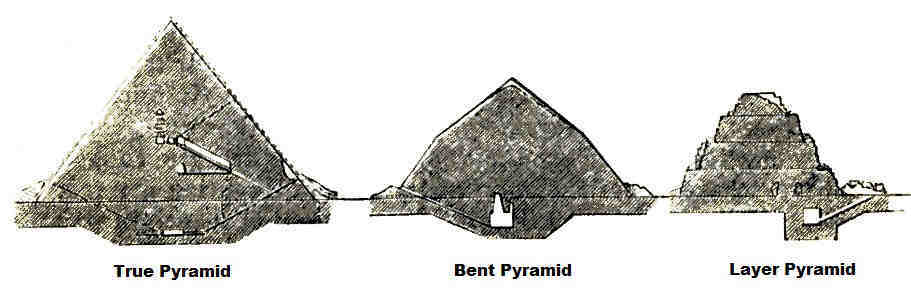
King Djoser's Step Pyramid at Saqqara Fact 10 Pyramid Development: The huge amount of stone required to build these massive structures were obtained from the Ancient Egyptian Stone Quarries. continued... Ancient Egypt - Pyramid Development Fact Sheet Pyramid Development Ancient Egypt - Pyramid Development Fact Sheet Fact 21 Pyramid Development: The 'Step Pyramid' was the first pyramid constructed in ancient Egypt by design rather than accident and is recognized as the first monumental stone structure ever built. It was the prototype of all future pyramids and built for King Djoser. Fact 22 Pyramid Development: The step design evolved into the 'Layer Pyramid' using thick, leaning layers of stone that were laid against a core, with sloping courses. Fact 23 Pyramid Development: The 'Meidum Pyramid' was the First True Pyramid because it was covered with one uniform slope of masonry with a smooth sided finish.
Meidum Step Pyramid Fact 24 Pyramid Development: The 'Bent Pyramid' of Snefru was the first attempt to construct a smooth-sided pyramid but the slope was too steep and the ancient Egyptian architects changed the angle of the monument halfway through its construction resulting in the 'bent' shape. The 'Bent Pyramid' funerary complex was the first to feature a 'Valley Temple'.
Fact 25 Pyramid Development: Snefru then constructed the Red Pyramid which was the tallest man-made structure in the world. Fact 26 Pyramid Development: The Snefru's son Khufu aka Cheops, built the Great Pyramid of Giza. The Great Pyramid of Giza is the oldest and largest of the three pyramids in the Giza Necropolis and was one of the Seven Wonders of the Ancient World. Fact 27 Pyramid Development: King Khafre aka Chephren built the second pyramid on the Giza plateau and King Menkaure built the smallest of the three Pyramids of Giza, Menkaure's Pyramid. Fact 28 Pyramid Development: Many other royal pyramids were built in ancient Egypt but were not as magnificent as those built at Giza in the 4th Dynasty - The Age of the Pyramids. Fact 29 Pyramid Development: The Pyramid of Ahmose was the last Royal Pyramid in ancient Egypt and signalled the end of the development of the great pyramid. Fact 30 Pyramid Development: The pyramid shape was, however, used as grave markers by ordinary, non-royal but wealthy Egyptians, who erected pyramid-shaped monuments as memorials.
Ancient Egypt - Pyramid Development Fact Sheet Facts about Pyramids Pyramid Development |